"Get Instant Astrology -no birth time required "

Blog
7/24/2026
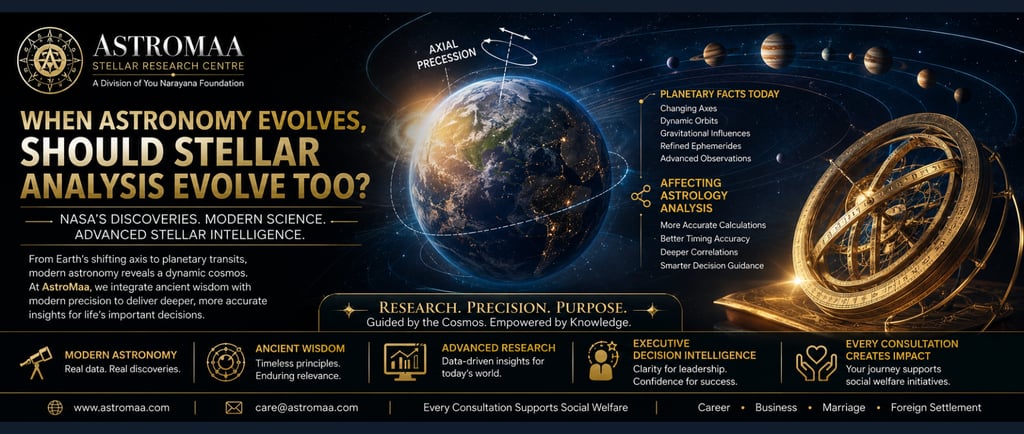
Why Modern Astronomy Is Reshaping Advanced Stellar Analysis
Astronomy and Astrology have often been portrayed as opposing disciplines.
Historically, however, they were inseparable.
Every ancient astronomical observatory existed because precise celestial observation was essential for understanding time, seasons, navigation, calendars, and ultimately, human civilization.
Today's space agencies—including NASA, ESA, ISRO, and JAXA—continue refining our understanding of planetary motion with extraordinary precision.
Their discoveries raise an important question:
Should modern stellar analysis also evolve with modern astronomical knowledge?
Astronomy Never Stops Improving
Space science continuously refines our understanding of:
• Planetary orbital mechanics
• Earth's axial precession
• Nutation and rotational variations
• Solar system dynamics
• Lunar motion
• Gravitational interactions
• Planetary ephemerides
Modern astronomical models today are significantly more precise than those available even a few decades ago.
Precision has become the foundation of every scientific observation.
The Earth's Axis Is Not Constant
One fascinating discovery in astronomy is that Earth does not maintain a perfectly fixed orientation.
Its rotational axis slowly changes over time through long-term astronomical cycles such as axial precession, while smaller periodic variations also occur.
These gradual changes influence the celestial reference framework used by astronomers.
For researchers working with stellar coordinates, this is not a minor detail.
It is fundamental.
Precision Matters
Whether launching satellites, navigating spacecraft, predicting eclipses, or calculating planetary positions, modern astronomy depends upon continuously updated observational data.
The same principle should apply to advanced stellar analysis.
If astronomical measurements become more accurate, analytical frameworks should also continue evolving.
Research should never become static.
Beyond Traditional Interpretation
At AstroMaa Stellar Research Centre, we believe the future of stellar research lies in integrating three essential dimensions:
• Ancient observational wisdom
• Modern astronomical precision
• Advanced analytical methodology
Rather than viewing astronomy and stellar analysis as competing disciplines, we believe they should complement each other.
Astronomy tells us where celestial bodies are.
Advanced Stellar Analysis seeks to understand how timing, celestial geometry, and long-observed cycles may correlate with human decision-making and life events.
These are different questions—but both require precision.
Research Over Assumptions
Every scientific discipline advances because researchers continue asking better questions.
The same philosophy should guide advanced stellar studies.
Instead of repeating centuries-old calculations without review, we believe researchers should continuously evaluate:
• Updated astronomical observations
• Modern computational ephemerides
• Long-term celestial cycles
• Coordinate reference systems
• Timing accuracy
• Statistical validation of observed correlations
This approach encourages responsible research rather than unquestioned tradition.
The Future
As astronomy enters an era of unprecedented precision, the opportunity also exists for stellar research to become more disciplined, transparent, and analytically rigorous.
The future belongs neither to blind belief nor automatic skepticism.
It belongs to thoughtful research.
That is the philosophy driving AstroMaa Stellar Research Centre.
Executive Intelligence begins with accurate observation.
Research begins with better questions.
And lasting wisdom grows when ancient knowledge evolves alongside modern science.
AstroMaa Stellar Research Centre
Executive Intelligence • Ancient Wisdom • Advanced Stellar Research
Every executive consultation supports the humanitarian initiatives of You Narayana Foundation.